
Articles
Turmeric Living Tonic: What’s Inside, How to Use It, and What to Know First
Oct
Come on in, family. Let’s talk about the golden root.
Turmeric is the bright gold root you may know from curry. Many people also enjoy it as part of a daily wellness habit. But a bottle of turmeric tonic can raise questions. What else is in it? How much do you take? Is it a good fit for you?
This guide answers those questions in plain words. We will walk through each herb in the Turmeric Living Tonic from 4 Cycles of Life, how each one has been used in tradition, how to take it, and how to stay safe.
What Is Turmeric Living Tonic?
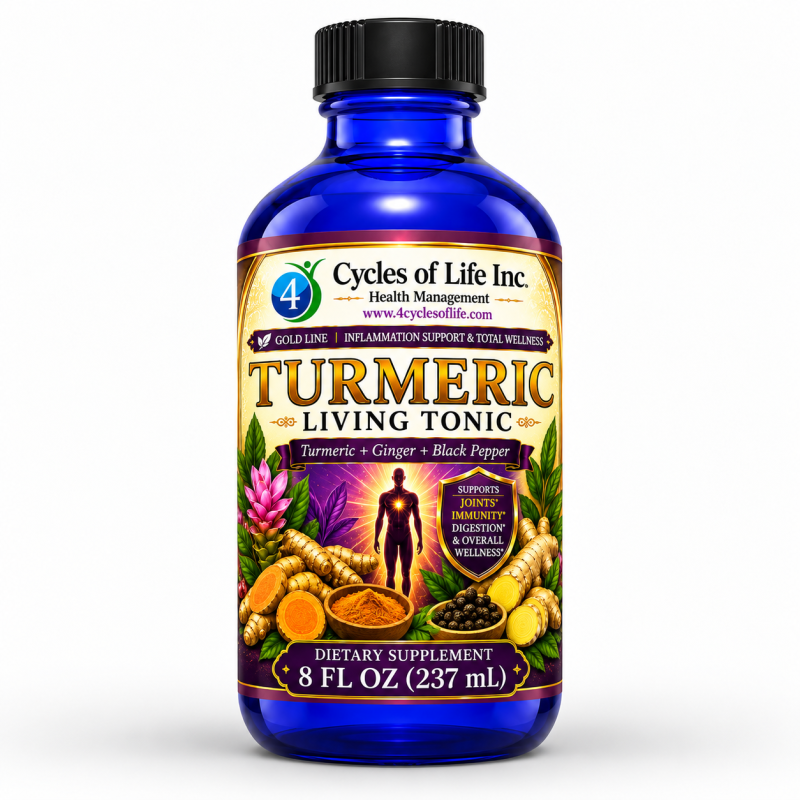
Turmeric Living Tonic is a liquid herbal blend in an 8 fl oz (237 mL) bottle. The product page calls it a plant-based, alcohol-free liquid dietary supplement.
It is made to complement joint wellness, digestion, immune wellness, and antioxidant support as part of your daily routine.*
Here are the basics at a glance:
| Detail | What the product page says |
|---|---|
| Size | 8 fl oz (237 mL) |
| Price | $29.99 |
| Form | Liquid dietary supplement |
| Herbal blend | Proprietary Herbal Blend, 2,000 mg |
| Suggested use | 2 teaspoons (10 mL) daily |
| Storage | Shake well. Refrigerate after opening. Best served chilled. |
What does “tonic” mean here?
In herbal tradition, a “tonic” is something people take a little of, often each day, as part of a routine. It is not a quick fix. Think of it like a daily habit, the same way some people drink a glass of water first thing in the morning.
What’s Inside: The Seven Herbs
The product page lists seven herbs in the main blend. Here they are, with what each one is and how it has been used in tradition.
1. Turmeric root extract (Curcuma longa)
Turmeric is a root in the ginger family. It gives curry its golden color. The yellow color comes from natural plant parts called curcuminoids. Curcumin is the best known of these.
Traditional use: Turmeric has a long history in the traditional practices of India (Ayurveda), China, and Thailand. It has been traditionally used to support digestion and joint comfort.*
2. Ginger root (Zingiber officinale)
Ginger is a spicy, warm root. You may know it from ginger tea or ginger ale.
Traditional use: Folk traditions have used ginger since ancient times. It has been traditionally used to support digestion and stomach comfort.*
3. Black pepper fruit extract (Piper nigrum), 95% piperine
This is the same plant as the black pepper on your table. Piperine is the part of black pepper that gives it its bite. The extract in this tonic is listed as 95% piperine.
Why it is paired with turmeric: Black pepper is often paired with turmeric. Piperine is one way makers help the body take in more curcumin. Taking in more is called “bioavailability.” (Please read the safety section below about this.)
4. Boswellia gum extract
Boswellia is a tree. Its gum, or sap, is dried into a resin. Frankincense comes from boswellia resin.
Traditional use: Boswellia has been traditionally used in Ayurveda to support joint comfort and ease of movement.*
5. Cayenne pepper fruit (Capsicum annuum)
Cayenne is a hot red chili pepper. It adds heat.
Traditional use: Cayenne has a long history as a warming spice in cooking and in folk practice.*
6. Licorice root (Glycyrrhiza glabra)
Licorice root is naturally sweet. It is not the same as most licorice candy. Many “licorice” candies in the U.S. use anise oil for flavor instead.
Traditional use: Licorice root goes back to ancient Egyptian, Greek, Arab, Chinese, Tibetan, and Indian traditions. Today it is often used to support digestive and respiratory wellness.* (Licorice also has important safety notes. See below.)
7. Ceylon cinnamon bark (Cinnamomum verum)
Ceylon cinnamon is sometimes called “true” cinnamon. It grows mostly in Sri Lanka. It is a different kind from cassia cinnamon, which is the most common cinnamon sold in North America.
Traditional use: Cinnamon has been part of cooking and traditional practices in China, India, and Persia for a very long time. It adds warmth and a sweet spice note.*
The other ingredients
The product page also lists these “other ingredients”:
- Distilled water
- Raw apple cider vinegar
- Vegetable glycerin
- Turmeric juice concentrate
- Lemon juice concentrate
- Natural flavor
Vegetable glycerin is a clear, sweet liquid made from plant oils. It is often used in alcohol-free herbal liquids.
Traditional Use vs. Research: What We Can and Can’t Say
It is important to be honest about what we know.
Traditional use means people have used an herb for a long time, often for many generations. That is real history. But it is not the same thing as proof from a study.
Research on single herbs exists. For example, researchers have studied turmeric, ginger, boswellia, and licorice on their own. But the U.S. National Center for Complementary and Integrative Health (NCCIH) says there is not yet enough strong evidence to say for sure that turmeric or curcumin helps with any health purpose. It says much the same about boswellia and licorice.
This tonic itself has not been tested in those studies. Studies on one herb, in one form and amount, do not tell us how a finished blend will work. So we do not make research claims about Turmeric Living Tonic. We share the herbs’ traditional use and how the product is meant to fit into your routine.*
How to Take Turmeric Living Tonic
The product page gives simple directions. Here they are as easy steps.
Step-by-step
- Shake the bottle well. Herbal liquids can settle at the bottom.
- Measure 2 teaspoons (10 mL). Use a real measuring spoon, not a dinner spoon. Dinner spoons come in many sizes.
- Take it your way. You can take it straight from the spoon. Or mix it into water or juice.
- Put the cap back on tight.
- Store it in the fridge after opening. The page says it is best served chilled.
That is one daily serving. The page says 2 teaspoons daily. Please do not take more than the label says.
How long does one bottle last?
An 8 fl oz bottle holds about 237 mL. At 10 mL a day, that is about 23 days of use. Your exact count may vary a little.
Simple ways to enjoy it
- Morning glass: Stir 2 teaspoons into a small glass of cool water with breakfast.
- Juice mix: Stir it into a little juice you already like.
- Straight and quick: Take it from the measuring spoon, then drink some water.
What does it taste like?
The product page does not describe the taste. Here is what the ingredient list tells us. The tonic has raw apple cider vinegar and lemon juice, which are tangy. It has cayenne, black pepper, and ginger, which bring heat. Licorice root and vegetable glycerin are naturally sweet. Cinnamon adds warm spice.
If you are new to it, start by mixing it into water. That makes the flavor softer.
Who May Enjoy Turmeric Living Tonic?
In general, this tonic may suit adults who:
- Want a simple daily routine with turmeric, ginger, and black pepper in one bottle.
- Like warm, spicy flavors.
- Prefer a liquid over capsules.
- Want an alcohol-free herbal liquid.
- Are looking for daily support for joint wellness and digestion as part of healthy habits like moving their body, eating well, and drinking water.*
It is not a replacement for any medicine or care your healthcare provider gives you. If you are unsure whether it fits you, please read the safety section and talk with your provider first.
Safety: Please Read Before You Start
Herbs are strong plants. Natural does not always mean right for every person. Please read these points.
Talk to your healthcare provider first if you:
- Are pregnant or nursing.
- Take any medicines, including prescription drugs. Some herbs and medicines can affect each other in harmful ways.
- Are managing any health condition.
- Are buying it for a child or teen.
- Have a surgery coming up.
Notes about specific herbs
These notes come from NCCIH fact sheets about each single herb. They are not test results for this tonic.
- Licorice root: Licorice has a natural part called glycyrrhizin. NCCIH reports that glycyrrhizin can cause serious problems, such as an irregular heartbeat, especially in large amounts or over a long time. Even small amounts have been linked to problems in people who eat a lot of salt, or who have high blood pressure, heart conditions, or kidney conditions. Licorice can also interact with corticosteroid (steroid) medicines.
- Turmeric with black pepper: NCCIH notes that liver damage has been reported in some people who used turmeric or curcumin products made to be better absorbed. Black pepper’s piperine is one way makers do this. If you notice signs like unusual tiredness, nausea, poor appetite, dark urine, or yellow skin or eyes, stop using it and call your healthcare provider right away.
- Turmeric and pregnancy: NCCIH says turmeric supplements may be unsafe during pregnancy.
- Stomach upset: Turmeric, ginger, and cinnamon can upset some people’s stomachs. Signs include heartburn, nausea, or loose stools.
Good habits for any herbal product
- Follow the label. Take only the suggested amount.
- Tell your healthcare provider about every herb and supplement you use.
- Stop using it if you notice anything unusual, and talk with your provider.
- Keep it in the fridge after opening, and keep it away from children.
If you have a question about your own health, please ask your healthcare provider. We can’t give personal medical advice in a blog post.
Frequently Asked Questions
How much Turmeric Living Tonic should I take?
The product page says 2 teaspoons (10 mL) daily. You can take it straight or mix it into water or juice.
Do I need to refrigerate it?
Yes, after opening. The page says to refrigerate after opening and that it is best served chilled. Shake it well each time.
Does it contain alcohol?
The product page lists it as alcohol free. It uses distilled water, raw apple cider vinegar, and vegetable glycerin as its base.
Why is there black pepper in a turmeric tonic?
Black pepper is often paired with turmeric. Its piperine helps the body take in more curcumin. Because of that, please read the liver safety note above.
Is this the same as turmeric tea or turmeric capsules?
No. This is a ready-to-use liquid with seven herbs. A tea is made by steeping dried herbs in hot water. Capsules are a dry powder in a shell. All three are different forms.
Can I take it if I take medicine?
Please ask your healthcare provider or pharmacist first. Licorice can interact with steroid medicines. Other herbs may interact with other medicines too.
Can I take it while pregnant or nursing?
Please talk with your healthcare provider before using it. NCCIH says turmeric supplements may be unsafe during pregnancy, and large amounts of licorice during pregnancy are unsafe.
How much turmeric is in each serving?
The page lists a 2,000 mg proprietary herbal blend. It does not list the amount of each herb. A “proprietary blend” means the maker shares the herbs but not each herb’s exact amount.
More From 4 Cycles of Life
If you enjoy warm, spicy herbs, you may also like these:
- Apple Cider Living Tonic is another 8 fl oz tonic. It pairs raw apple cider vinegar with Ceylon cinnamon, ginger, turmeric, and apple and cranberry concentrates.
- Golden Glow Herbal Tea Blend is a caffeine-free tea with chamomile, ginger, lemongrass, apple, lemon, and Ceylon cinnamon.
- Tea Time LIVE – Build Your Own Custom Herbal Tea lets you choose your own herbs for a 2 oz blend. Turmeric root and ginger root are among the choices.
- Browse the Bitter Tonics collection, which has all of our 8 oz tonics and herbal bitters.
4 Cycles of Life is a Black-owned herbal shop and tea bar. We started online in Arizona in July 2014, and on October 3, 2026, we opened our storefront at 8110 W Peoria Ave, Ste 103, in Peoria, Arizona. You can read our story on our About page. If you’re in the West Valley, come on in, family: we’re open Tuesday through Friday, 10:30am to 5:30pm, and Saturday, 9am to 2pm. Not local? We still ship nationwide, like we have since 2014.
Ready to Try It?
If a warm, spicy daily tonic sounds like a good fit for your routine, you can read the full ingredient list and order on the Turmeric Living Tonic product page. Shake it well, measure your 2 teaspoons, and make it part of your daily habit.*
Share this with your family members and loved ones. Mother Nature is your gift to healthy living.
These statements have not been evaluated by the Food and Drug Administration. This product is not intended to diagnose, treat, cure, or prevent any disease. Always talk to your healthcare provider before starting any new supplement or herbal product, especially if you are pregnant, nursing, taking medication, or managing a health condition.
